

GEO, AEO, and AIO are three labels used to describe how brands improve visibility as search becomes more conversational and AI-generated answers become part of discovery. For apartment communities, the practical question is simple: when a renter asks an AI-powered search experience about apartments, amenities, pricing, policies, floor plans, or locations, can that system find, understand, trust, and accurately represent your property?
The terminology is less settled. GEO usually means Generative Engine Optimization. AEO usually means Answer Engine Optimization. AIO often means AI Optimization, although marketers also use AIO as shorthand for AI Overviews. Some sources separate these strategies into distinct layers. Others treat them as overlapping names for much of the same work. Google itself says that, from its Search perspective, AEO and GEO remain part of SEO.
That disagreement matters. Property owners and managers do not need three disconnected marketing programs simply because the industry created three acronyms. You need a strong digital foundation that works for renters, search engines, local discovery, and the growing number of AI-mediated search experiences.
Terminology note: In this article, GEO means Generative Engine Optimization, not geographic targeting, geofencing, or local geo-targeting. We use AIO as the broad umbrella for AI-search optimization, while recognizing that the industry has not agreed on one universal vocabulary.
What GEO, AEO, and AIO Mean in Multifamily Marketing
GEO: Generative Engine Optimization
GEO focuses on visibility inside answers created by generative systems. The term was formalized in a 2023 research paper that studied how content could gain visibility when a generative engine synthesizes information from several sources instead of returning only a list of links.
For an apartment community, GEO can apply when a renter asks a question such as, “Which apartments in this area have covered parking and in-unit laundry?” The system may assemble an answer from indexed websites, listings, local information, and other sources available to that particular platform.
Your GEO work therefore involves more than writing one blog post. It includes the quality of your website, factual property information, local presence, useful content, crawlability, reputation signals, and consistency across the places where your community appears online.
AEO: Answer Engine Optimization
AEO focuses more narrowly on making information suitable for direct answers. Think about questions with clear factual responses: office hours, parking options, apartment features, floor-plan details, application steps, pet policies, or the distance to a nearby transit stop.
Good AEO does not mean writing hundreds of tiny FAQ pages. It means answering important renter questions clearly, putting the answer where people can find it, and keeping the underlying facts accurate.
AIO: AI Optimization
AIO is best treated as an umbrella term in this guide. It describes the broader work of making a brand, website, data, content, and digital presence understandable and useful to AI-powered discovery systems.
That can include SEO, AEO, GEO, local search, structured information, reputation, content quality, measurement, and the systems used to keep property facts current. Other marketers define AIO differently, which is another reason owners should evaluate the work being proposed rather than buying a label.
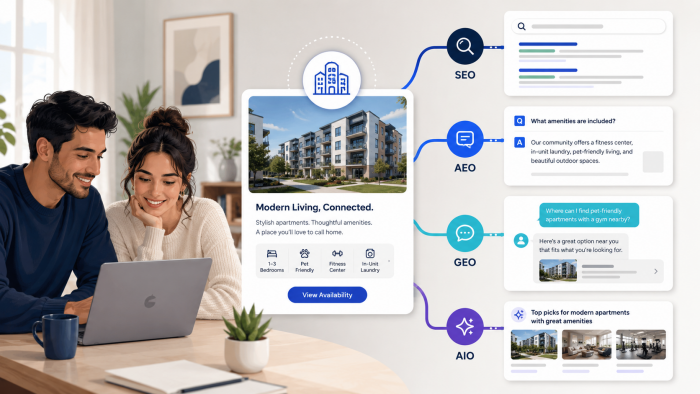
SEO vs. AEO vs. GEO vs. AIO for Apartment Marketing
| Strategy | Primary focus | Apartment example | Useful outcome |
|---|---|---|---|
| SEO | Make pages crawlable, relevant, useful, and competitive in organic search. | A floor-plan or location page appears when renters search for apartments in a local market. | Organic visibility, clicks, qualified website visits, and downstream leasing opportunities. |
| AEO | Provide clear answers to specific questions. | A renter asks whether a property has a certain amenity or what a stated fee covers. | Accurate direct answers and stronger visibility for question-driven discovery. |
| GEO | Improve the chance that generative systems use, mention, or cite your information. | An AI system synthesizes several apartment options that fit a renter’s detailed request. | AI mentions, citations, recommendation visibility, and assisted discovery. |
| AIO | Coordinate the wider AI-search visibility program. | The property aligns its website, listings, local presence, content, technical SEO, and measurement. | A more accurate and discoverable property entity across multiple search experiences. |
The most important column is not the acronym. It is the outcome. If a proposal promises “GEO” but ignores crawlability, stale apartment information, weak local listings, or a poor renter experience after discovery, the strategy has skipped the foundation.
When we work on apartment SEO, we look beyond rankings. The property website, local visibility, content, and the path from search to inquiry all affect whether visibility can become a leasing opportunity.
Why AI Search Matters to Apartment Owners and Property Managers
AI is becoming part of renter discovery, but the current picture deserves some restraint. Apartments.com reported in 2026 that about 5% of renters said they were using or planning to use a generative AI chatbot during their rental search, based on a survey of more than 15,000 U.S. adults. That is meaningful growth, but it does not mean traditional apartment search has disappeared.
Direct chatbot use is only one part of the change. AI is also being built into the search experiences renters already use. Apartments.com introduced conversational AI search that lets renters describe detailed requirements in natural language. Google is also integrating generative experiences into Search.
This creates an important measurement distinction for owners: the percentage of renters opening a standalone chatbot is not the same as the percentage encountering AI somewhere in the apartment-search journey.
It also explains why abandoning SEO to chase a new acronym would be premature. Google’s current guidance says its generative AI features are rooted in core Search ranking and quality systems. Strong technical SEO and useful content remain foundational.
How AI Discovery Can Work for an Apartment Community
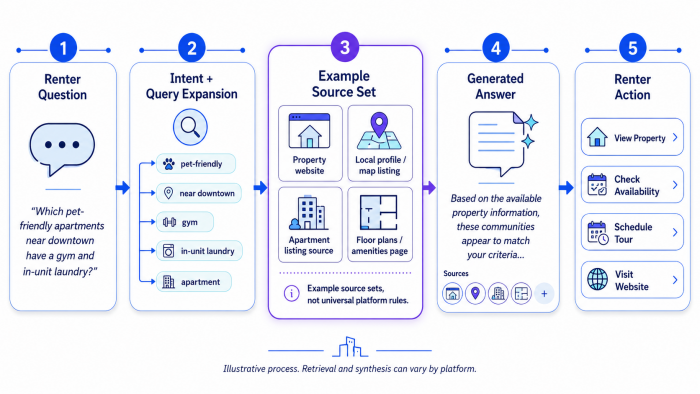
A traditional search often looks like a short query followed by a list of links. An AI-assisted apartment search can add another layer. The renter describes several requirements at once, the system interprets those constraints, retrieves information, and produces a synthesized response.
The prompt may combine location, price range, apartment features, parking, transit, or other practical requirements.
Instead of matching only one keyword, the system can break the request into several related information needs.
Available sources vary by platform and may include indexed webpages, listings, local data, and other accessible information.
Your property may be mentioned, compared, cited, linked, or omitted depending on the query and available evidence.
That next step may be a website visit, listing view, call, message, tour, application, or another comparison.
No single source mix applies to every AI platform. That is why statements such as “ChatGPT always pulls from X” or “one type of schema guarantees citations” should be treated cautiously.
How to Optimize an Apartment Website for GEO and AEO
1. Establish a reliable source of truth for property facts
Start with information that can affect a renter’s decision. Review your property name, address, contact information, office hours, floor plans, amenity details, parking information, stated fees, policies, availability, and other factual property content.
Then compare those facts across the property website, major listing sources, and local profiles you control. If one source says an amenity exists and another says it does not, the problem is larger than GEO. A prospect may also receive conflicting information.
2. Make important renter information crawlable and easy to find
A critical property fact should not exist only inside a difficult widget, an image with no supporting text, or a document that renters struggle to use on mobile. Important content should have a logical place within the website architecture.
Floor-plan information, amenity details, neighborhood facts, contact information, leasing steps, and property policies should be clear to the renter first. Search visibility benefits when the same content is also accessible to search systems.
3. Answer real renter questions directly
Question-based content is useful when the question reflects an actual decision. An answer about parking, move-in costs, floor-plan dimensions, availability, application steps, or an amenity can remove friction before a tour or inquiry.
Do not manufacture a separate page for every possible wording of the same question. Google’s current generative-search guidance specifically warns against creating large quantities of pages around fan-out query variations simply to manipulate visibility.
4. Use structured data for what it actually does
Structured data can give search engines explicit machine-readable information about a page and can support eligible Search features. It should match what a visitor can see on the page.
It is not a magic GEO switch. Google states that structured data is not required for its generative AI search experiences and that there is no special schema.org markup required for them. Google also says sites do not need special AI markup or an LLMS.txt file to appear in Google Search’s generative features.
A useful rule: Mark up content because the schema correctly describes the page and supports a valid search use case. Do not add invented apartment, review, pricing, or availability data merely because someone labels it “AI schema.”
5. Keep local property information aligned
Apartment discovery is local by nature. Your website and local business presence should agree on basic property facts. A current Google Business Profile, accurate contact information, relevant photos, and consistent local citations support discovery even before AI optimization enters the conversation.
For a portfolio, consistency should not turn into copy-and-paste sameness. Shared systems can standardize the fields you maintain, while each community still needs accurate property-specific content, local information, floor plans, amenities, photos, and leasing details.
6. Create information worth retrieving
AI-search visibility is unlikely to become durable if every page repeats the same generic apartment language. Useful content answers questions that cannot be resolved by changing the city name in a template.
For multifamily properties, that may include clear floor-plan explanations, verified location details, amenity specifics, transportation facts, parking information, comparison guidance, leasing-process information, or other property-level details renters genuinely need.
7. Support the content with useful visuals
Apartment search is highly visual. Photos, floor plans, maps, and virtual tours help prospects evaluate a property in ways text cannot. Google also recommends using relevant images and video as part of content intended to perform well across Search, including generative AI experiences.
Apartment GEO, AEO, and AIO Implementation Checklist
| Area | Check | Why it matters |
|---|---|---|
| Property data | Confirm core facts across the website and listings. | Conflicting facts create renter friction and make reliable representation harder. |
| Technical SEO | Review crawlability, indexability, internal links, mobile usability, and page performance. | AI visibility does not remove the need for a strong search foundation. |
| Renter questions | Answer high-value questions in plain language. | Clear answers support both renter decisions and answer-driven discovery. |
| Local visibility | Maintain accurate business information, photos, and local citations. | Apartment discovery often includes a local-intent layer. |
| Structured data | Validate supported markup and make sure it matches visible content. | Correct markup can support Search understanding and eligible features without being an AI shortcut. |
| Content quality | Add original, property-specific information instead of generic location-swapped copy. | Useful information creates more reasons for a system and renter to rely on your page. |
| Measurement | Track visibility, referrals, inquiries, tours, applications, and leases separately. | An AI mention is not automatically a qualified lead or signed lease. |
How Do You Get an Apartment Website Cited in AI Answers?
There is no reliable tactic that guarantees a citation in ChatGPT, Gemini, Google AI Mode, Perplexity, or another generative system. The engines have different retrieval systems, source sets, prompts, personalization, and product behavior.
A better objective is to make the property an easy source to retrieve and verify when it is relevant.
- Publish clear facts. Make important property information explicit rather than hiding it inside vague promotional language.
- Keep facts current. Pricing, availability, fees, policies, and office information can change. Stale content is a renter-experience problem even before it becomes an AI problem.
- Create useful original information. Explain the property, floor plans, amenities, location, and leasing process in ways generic apartment copy cannot.
- Maintain crawlable webpages. If a search system cannot reliably access important content, optimization further down the funnel has limited value.
- Build legitimate visibility beyond your own site. Accurate listings, local profiles, earned coverage, and authentic reviews can contribute additional information about the property. Do not manufacture mentions.
- Keep the website useful after the citation. A renter who clicks through still needs clear floor plans, photos, availability, contact options, and an understandable leasing path.
Citation and mention are different metrics. A property can be named in an AI answer without a source link. It can also be linked as a source without becoming the main recommendation. Track the two separately.
How to Measure GEO, AEO, and AIO Performance
AI visibility creates a measurement problem that traditional rank reports do not fully solve. A renter may see your community in a generated answer without visiting the property website. Another renter may click a citation, return later through direct traffic, and schedule a tour through a different system.
Google began rolling out a dedicated generative AI performance report in Search Console in June 2026. The report can show impressions from AI Overviews and AI Mode, but Google has been rolling access out to a subset of properties rather than every site at once.
That is useful data, but owners still need a broader scorecard.
| Metric | What it tells you | What it does not prove |
|---|---|---|
| AI mentions | How often a property appears within a controlled set of relevant prompts. | That the property earned a click, inquiry, or lease. |
| AI citations | Whether your site or another controlled property source is cited or linked. | That the linked source was the deciding factor in the recommendation. |
| AI referral traffic | Visits that analytics can attribute to supported AI referral sources. | Total AI exposure, since many answers create no website visit. |
| Answer accuracy | Whether important property facts are represented correctly. | That renters are choosing the property. |
| Qualified leads and tours | Whether discoverability is producing useful leasing opportunities when attribution is available. | That those opportunities will become applications or leases. |
| Applications and signed leases | How apartment marketing opportunities progress into stronger business outcomes. | That GEO alone caused the lease. Pricing, availability, market demand, reputation, onsite follow-up, and other channels also matter. |
Prompt tracking also needs discipline. Use a stable set of renter questions, document the platform and date, repeat the test over time, and separate branded prompts from discovery prompts. One favorable screenshot is not a trend.
Google also warns that third-party tools do not have access to its internal ranking or AI systems. AI-visibility platforms can still help organize testing and reporting, but claims of proprietary access to Google’s internal AI ranking data deserve scrutiny.
We separate marketing visibility from leasing outcomes. A mention, impression, website session, qualified lead, tour, application, and signed lease answer different performance questions. Combining them into one “AI ROI” number can hide where the renter journey is actually working or breaking.
Is GEO Worth the Budget for an Apartment Community?
GEO deserves attention, but it should not automatically become a new budget line that competes with every existing channel. First identify what is already broken.
| Property situation | Priority | Reason |
|---|---|---|
| Website has technical SEO or mobile problems | Fix the foundation first | A new GEO service cannot compensate for a property site that search systems or renters struggle to use. |
| Property facts conflict across channels | Correct data consistency | Accurate information improves both renter experience and machine understanding. |
| SEO foundation is strong but content is generic | Invest in useful property-specific content | Unique, clear information gives search systems and renters more substance to work with. |
| Managing a large portfolio | Standardize the process, not the copy | Central data governance can scale, while each community still needs accurate local and property-level information. |
| Lease-up property | Build discoverability early | Publish verified location, floor-plan, amenity, contact, and leasing information as it becomes available, then keep it updated through launch. |
The ROI question should eventually reach leasing performance. If your community becomes more visible in AI answers but qualified inquiries, tours, applications, and signed leases do not improve, investigate the rest of the renter journey before assuming the visibility itself is valuable.
Which Tools Help With Apartment GEO and AEO?
You do not need a completely new technology stack before starting. Most multifamily teams need several tool categories rather than one “GEO platform.”
Vicin is one example of a marketing platform that incorporates AI-related capabilities alongside broader marketing and analytics tools. It shows how AI is being integrated into existing marketing workflows rather than operating only as a separate GEO or AEO function.
Depending on your portfolio and measurement goals, useful tools may fall into several categories:
- Search monitoring: Search Console can help evaluate indexing and organic visibility, with generative AI reporting available to eligible properties as Google expands access.
- Website analytics: Use analytics to identify AI referral traffic where referral information is available and follow those sessions into meaningful conversion actions.
- Structured-data validation: Validate markup against the standards and search features you actually use.
- Local listing management: Monitor core property information across important local profiles and directories.
- AI visibility tracking: A specialized platform can automate prompt monitoring, citations, and competitor comparisons, but evaluate how it gathers data and what its metrics actually mean.
- Manual testing: Periodic controlled prompts remain useful for checking how a property is described, especially for factual accuracy.
Tool selection should follow the measurement plan. Buying an AI-visibility dashboard before deciding which properties, prompts, competitors, and leasing outcomes matter can produce an impressive report without a clear business decision behind it.
Common GEO and AEO Mistakes in Multifamily Marketing
Treating GEO as a replacement for SEO
For Google Search, this directly conflicts with current platform guidance. SEO fundamentals remain relevant to generative features. GEO is better understood as an expansion of the visibility problem, not permission to stop maintaining the website.
Creating hundreds of near-duplicate question pages
Query fan-out is useful for understanding renter intent. It is not a command to publish one page for every query variation. Consolidate related questions when one strong page can satisfy them naturally.
Chasing special AI markup
There is no special schema required for Google’s generative Search features. Accurate, valid structured data can still support conventional Search understanding and eligible rich-result features, but it should not be sold as a guaranteed AI citation mechanism.
Trying to manufacture third-party mentions
Authentic reputation and independent discussion can be useful sources of information. Artificial mentions, fabricated reviews, and spam campaigns introduce risk without creating reliable authority. Google specifically warns against seeking inauthentic mentions as an AI-search tactic.
Letting pricing, policies, or availability go stale
A beautifully optimized answer is still a bad renter experience if the fact itself is wrong. Set ownership for information that changes frequently. The person responsible for marketing content should know where the authoritative property data comes from and how updates reach the website and listings.
Reporting visibility as if it were leasing ROI
An AI mention can be useful exposure. It is not a signed lease. Owners need to see the path from visibility to site engagement, qualified leads, tours, applications, and leases where attribution allows it.
A Practical GEO, AEO, and AIO Priority Order
If you are responsible for one apartment community or a national portfolio, the work is easier to manage when it follows a sequence.
Identify the authoritative source for pricing, availability, policies, floor plans, amenities, hours, and contact information.
Make sure important pages can be crawled, indexed, navigated, and used comfortably on mobile.
Fill information gaps with clear, property-specific content based on real renter decisions.
Review local profiles, important listings, reputation, and other sources that represent the community.
Track AI visibility without losing sight of qualified leads, tours, applications, signed leases, and the limits of attribution.
This sequence also makes budgeting easier. The same website improvement may strengthen traditional SEO, AEO, GEO, local visibility, and renter conversion at once. That is usually more valuable than building an isolated “AI page” that serves no clear renter need.
Frequently Asked Questions About GEO, AEO, and AIO for Apartments
Are GEO and AEO the same thing?
Not always. AEO is commonly used for direct-answer optimization, while GEO often describes visibility in synthesized generative responses. Some marketers use the terms almost interchangeably. There is no universally accepted boundary.
Is AIO the same as GEO?
It depends on the source. Some use AI Optimization as an umbrella that contains GEO and AEO. Others use AIO for a strategy very similar to GEO. AIO can also be shorthand for AI Overviews, so define the term before comparing services.
Does GEO replace apartment SEO?
No. Traditional SEO still supports crawlability, organic discovery, local search, useful page structure, and website traffic. Google’s current guidance says SEO best practices remain foundational for its generative Search experiences.
Does an apartment website need special AI schema?
Not for Google Search. Google says there is no special schema.org markup required for its generative AI search features. Continue using valid structured data when it accurately represents the visible page and supports a real Search use case.
Does an apartment website need an LLMS.txt file for Google?
No. Google states that it does not use LLMS.txt or other special AI text files for Search visibility. Another service could choose to support such a file, so the answer can differ outside Google.
Do FAQs help with AEO?
They can help when they answer real renter questions clearly. The value comes from the useful visible content, not from creating a large FAQ simply to target keyword variations.
Can an apartment community appear in an AI answer without getting a website click?
Yes. A generated response may mention a property or summarize information without producing a visit. That is why AI mentions, citations, referral traffic, and leasing conversions should be tracked as separate measurements.
Should every apartment property in a portfolio use the same GEO strategy?
The operating framework can be standardized, but the content should reflect each property. Location, pricing, availability, amenities, floor plans, reputation, competition, and leasing priorities differ from community to community.
How often should property managers check AI answers about their communities?
Use recurring monitoring rather than a one-time test. The right cadence depends on how quickly the property’s information changes and how important AI discovery is to the marketing program. Use a consistent prompt set so changes are easier to interpret.
The Best GEO Strategy Starts With Better Apartment Marketing Fundamentals
GEO, AEO, and AIO describe a real change in digital discovery, but the acronyms can make the work sound more separate than it is. Apartment communities still need accurate information, a technically sound website, useful local content, strong property presentation, current listings, and a renter journey that makes the next step easy.
AI adds another destination for that information. It also adds new questions: Is the property being mentioned? Is it cited? Are the facts correct? Does visibility lead to qualified leasing activity?
For owners and property managers, that is the practical definition of AI optimization. Make your community easier to find, easier to understand, accurately represented, and easier for a renter to evaluate wherever discovery happens.
Build AI Visibility on a Stronger Apartment Marketing Foundation
Market Apartments works across apartment websites, SEO, local visibility, content, and leasing-focused marketing. If you want to evaluate how your property appears across traditional and emerging AI-driven search experiences, start with an audit of the full renter discovery path.
Related posts:




Categorised in: Apartment Marketing, For Property Managers, Market Apartments Services
This post was written by Isabella Lagman

Isabella Lagman is a versatile professional writer with a genuine passion for language and storytelling. With over a decade of experience writing about apartment marketing, property management, and the real estate industry, she specializes in creating clear, engaging content that connects with both industry professionals and everyday readers. Her work spans a wide range of formats, from creative storytelling and lifestyle content to informative articles and technical documentation, allowing her to bring both creativity and precision to every project.